
Latest Wooden Front Door Designs for Modern Indian Homes in 2026
Explore modern wooden front door designs that balance style, material quality, and everyday practicality.
The best wooden front door designs for modern Indian homes combine natural wood textures, clean lines, durable finishes, and secure hardware. Popular choices include vertical fluted doors, teak wood panels, walnut finishes, geometric patterns, brass accents, and traditional carved designs. For homeowners in Delhi NCR, the right choice depends on the home's architecture, entrance size, exposure to weather, maintenance needs, and budget.
Your main door does more than connect your home to the outside world. It sets the tone for your interiors before anyone even steps inside. Whether you have recently purchased an apartment in Noida, a builder floor in Ghaziabad, or a villa in Gurgaon, a thoughtfully selected wooden entrance door can make your home feel more welcoming and complete.
But how do you choose a design that looks beautiful today and still works well years from now?
Let's explore the latest wooden front door designs, suitable materials, popular finishes, practical buying tips, and mistakes to avoid before making your decision.
Which Wooden Front Door Design Should You Choose?
Start with your home's architecture, available entrance space, and daily requirements. A minimalist wooden door may suit a contemporary apartment, while a carved teak entrance may feel more appropriate in a traditional independent house.
Here is a quick guide to help you decide.
| Your home or preference | Wooden door design to consider |
|---|---|
| Modern apartment | Minimalist flush or vertical-grooved door |
| Luxury flat in Gurgaon or Noida | Walnut finish with brass or matte black hardware |
| Independent house or villa | Solid wood panels or a double-door design |
| Traditional Indian home | Carved wood or a panelled door |
| Small entrance | Light wood finish with simple vertical lines |
| Contemporary luxury interiors | Fluted wood with concealed or minimal hardware |
| Low-maintenance home | A suitable engineered door or veneer finish with a compatible protective coating |
Our design tip: Do not choose a main door in isolation. Look at the flooring, entrance wall, foyer lighting, and nearby furniture together. A door that coordinates with these elements usually creates a more cohesive entrance than one chosen only because it looks attractive in a catalogue.
12 Latest Wooden Front Door Design Ideas
These wooden main door designs cover contemporary apartments, premium homes, and traditional Indian entrances. Choose the style that fits your space rather than following a trend simply because it is popular.
1. Minimalist Wooden Main Door
A minimalist wooden door uses a clean surface, subtle grain, and very little ornamentation. It works particularly well in modern apartments where the entrance should feel refined without competing with the rest of the interiors.
Choose a natural oak-inspired, teak, or walnut finish depending on your colour scheme. A simple long handle and a well-finished frame can complete the look.
Best for: Modern flats, compact entrances, and neutral interiors.
What to consider: Minimalist designs leave little room to hide poor workmanship, so the finish, edges, alignment, and hardware need attention.
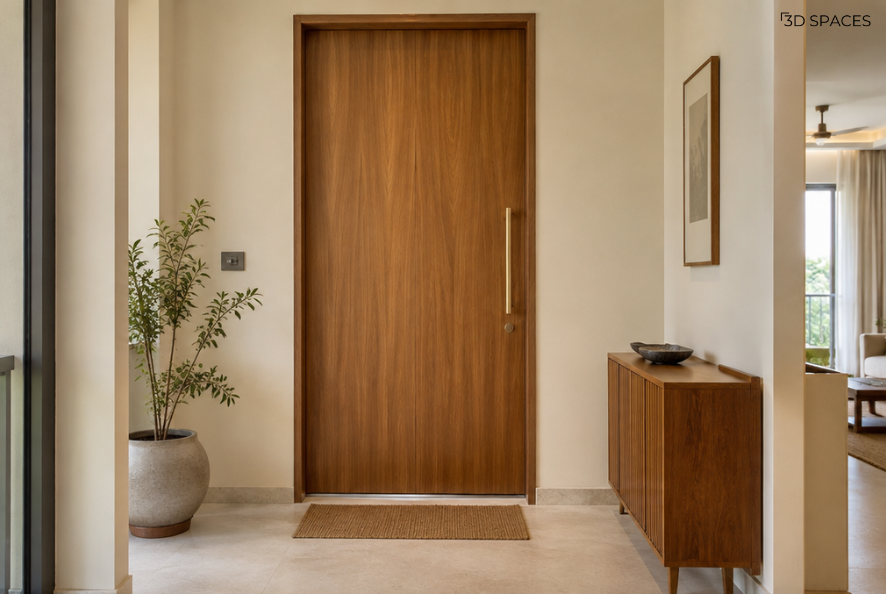
A minimalist teak-finish main door creates a warm, uncluttered entrance for a modern apartment.
2. Vertical Fluted Wooden Door
Fluted wooden doors feature narrow vertical grooves that create depth through light and shadow. This design has become a popular contemporary choice because it adds texture without relying on heavy carving or decorative panels.
Pair the grooves with a long handle and a matte finish. For a cohesive entrance, repeat the vertical detailing on a nearby foyer wall or console unit.
Best for: Contemporary apartments, luxury interiors, and modern builder floors.
What to consider: Deep grooves can collect dust. Ask the carpenter or manufacturer how the surface will be finished and cleaned.
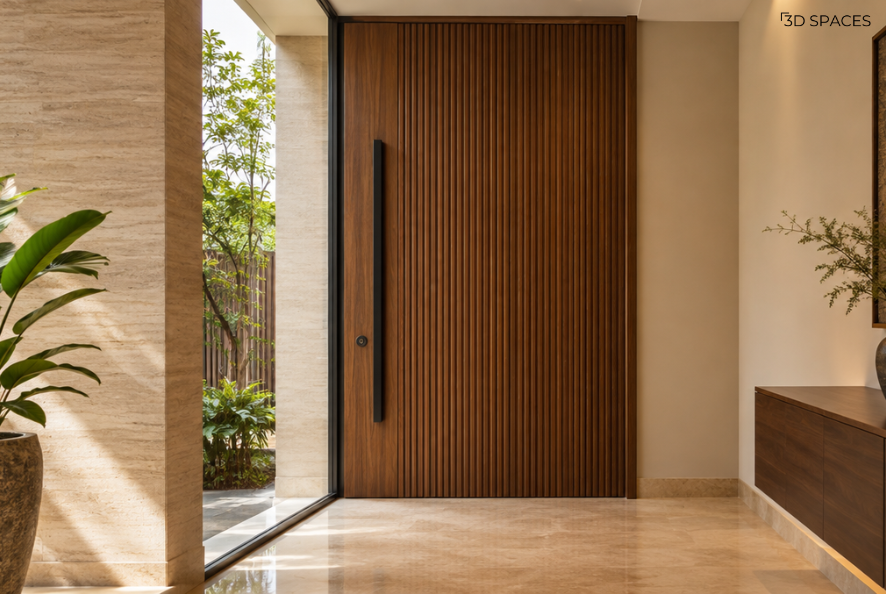
Vertical fluting gives a modern wooden entrance door a subtle architectural finish.
3. Teak Wood Main Door
Teak is a classic choice for Indian main doors. Its natural grain and warm brown tones suit both traditional and contemporary homes. It is also valued for its natural durability, although the performance of an installed door depends on timber quality, construction, exposure, and maintenance.
A simple teak panel door can feel timeless, while a contemporary design with broad panels and understated hardware gives it a more modern look.
Best for: Independent houses, premium apartments, and homeowners who prefer natural timber.
What to consider: Confirm the wood species, grade, moisture condition, source, and finish before purchasing. A teak-look laminate or veneer is not the same as a solid teak door.
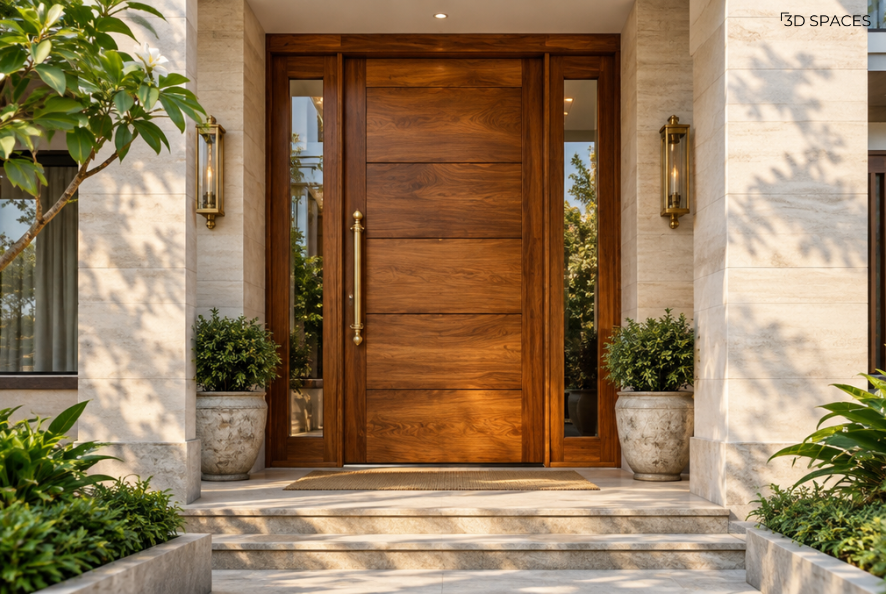
A teak wood main door brings natural warmth and timeless character to an Indian home.
4. Dark Walnut Wooden Front Door
Dark walnut and walnut-inspired finishes give an entrance a rich, sophisticated appearance. They work particularly well with cream walls, beige stone, warm lighting, and brushed brass or matte black hardware.
For a balanced look, keep the surrounding surfaces relatively simple. A dark door against a lighter wall creates contrast without requiring additional decoration.
Best for: Luxury apartments, modern villas, and contemporary interiors.
What to consider: Dark finishes can make a small entrance feel visually heavier. Check the sample in your actual lighting before finalising the shade.
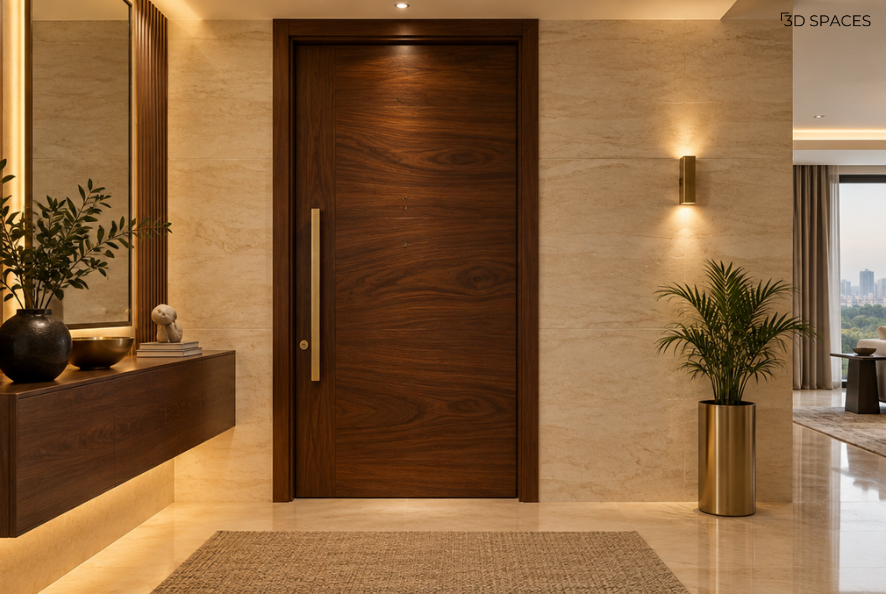
A dark walnut finish adds depth and contrast to a contemporary entrance.
5. Wooden Door with Brass Inlays
Brass strips, geometric inlays, and understated metallic detailing can make a plain wooden door feel more distinctive. The contrast between warm wood and metal creates a premium look without needing elaborate carving.
Choose a restrained pattern if the home already has statement lighting, marble flooring, or decorative wall panels.
Best for: Premium apartments, contemporary villas, and homeowners who like subtle luxury.
What to consider: Check how the inlays are fixed, whether the metal finish is suitable for the environment, and how the detailing will be cleaned.
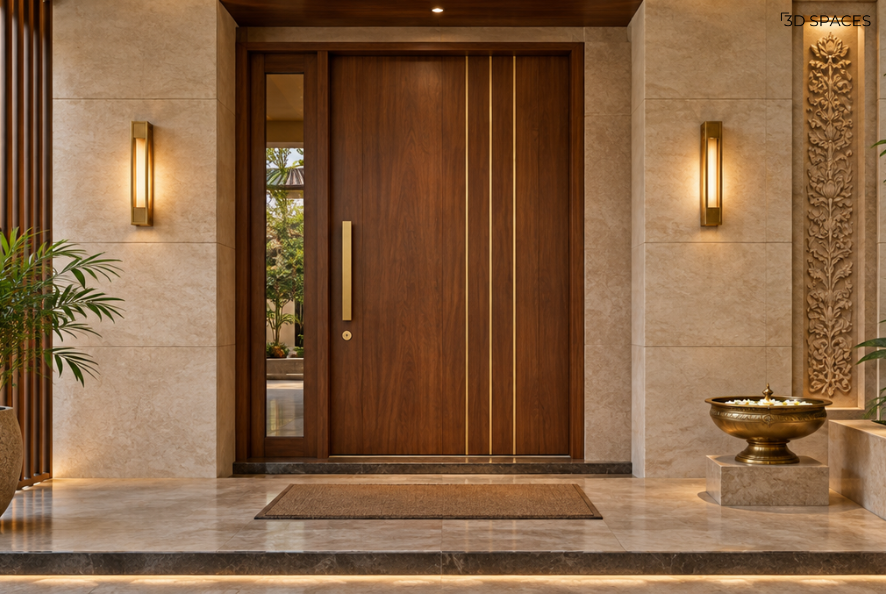
Brass inlays create a refined focal point on a contemporary wooden entrance door.
6. Geometric Panel Wooden Door
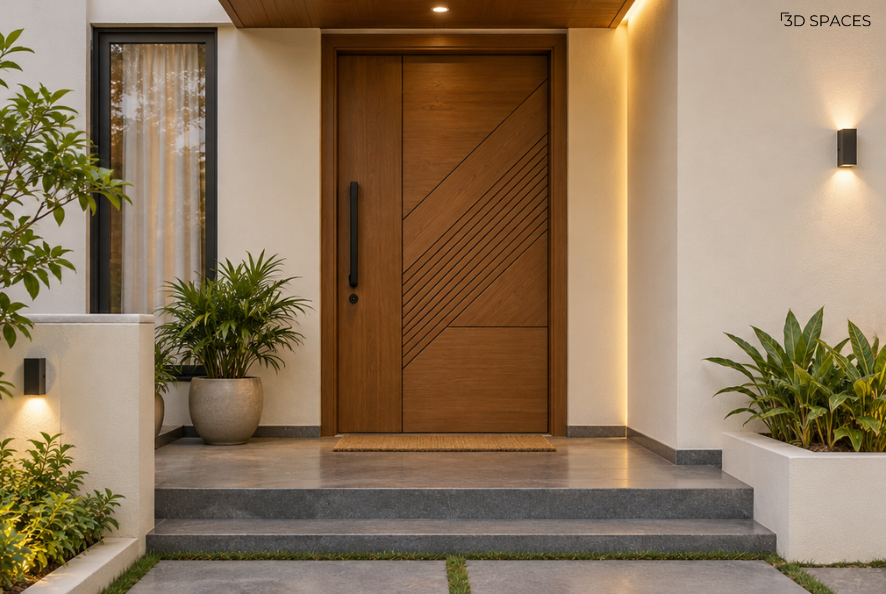
Geometric wooden panels add structure and visual interest without excessive decoration.
Geometric designs use rectangular panels, diagonal lines, or carefully arranged shapes to give the door a more architectural appearance.
This style works well when you want something more distinctive than a plain flush door but prefer a modern look over traditional carving.
Best for: Contemporary homes, modern builder floors, and geometric interior schemes.
What to consider: Keep the pattern proportional to the door size. Too many intersecting lines can make a compact entrance look busy.
7. Traditional Carved Wooden Main Door
Carved wooden doors remain a strong choice for homeowners who appreciate traditional Indian craftsmanship. Floral motifs, symmetrical patterns, and decorative borders can make an entrance feel distinctive and connected to heritage design.
A carved door can also work in a contemporary home when the surrounding walls, flooring, and lighting are kept simple.
Best for: Independent houses, traditional interiors, and villas with heritage-inspired details.
What to consider: Detailed carving increases the effort required for cleaning and may affect the overall cost. Choose a pattern that suits the home's architecture rather than making the door the only decorative feature.
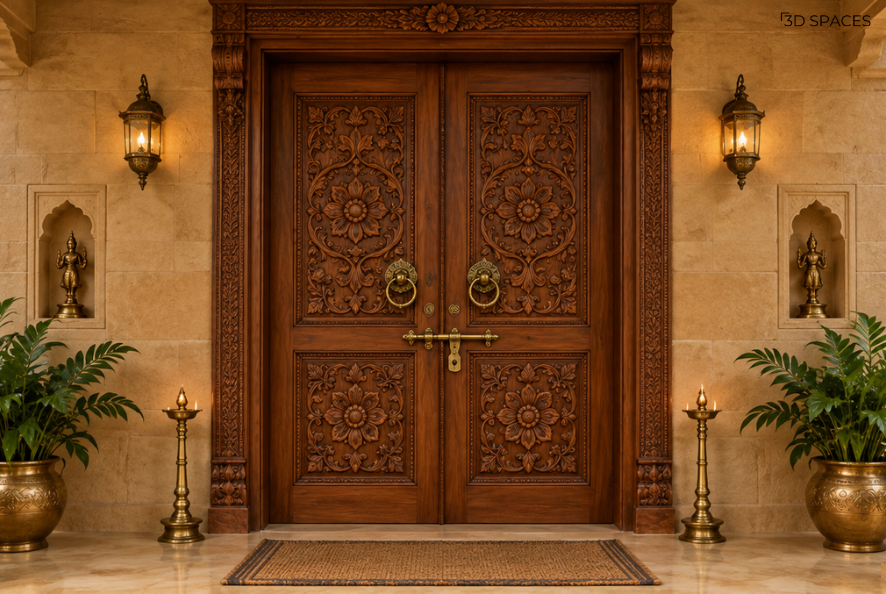
Traditional carving brings craftsmanship and cultural character to a wooden main door.
8. Wooden Door with Glass Side Panels
Narrow glass panels beside a wooden door can introduce natural light into a dark entrance. Frosted or appropriately obscured glazing helps maintain privacy while allowing daylight to filter through.
For apartments, the feasibility depends on the existing doorway and building rules. For independent houses, side panels can be planned as part of the entrance architecture.
Best for: Independent houses, villa entrances, and homes with limited natural light near the foyer.
What to consider: Use suitable safety glazing, privacy treatments, and secure framing. Avoid compromising security for the sake of daylight.

Frosted glass side panels bring daylight into an entrance while helping preserve privacy.
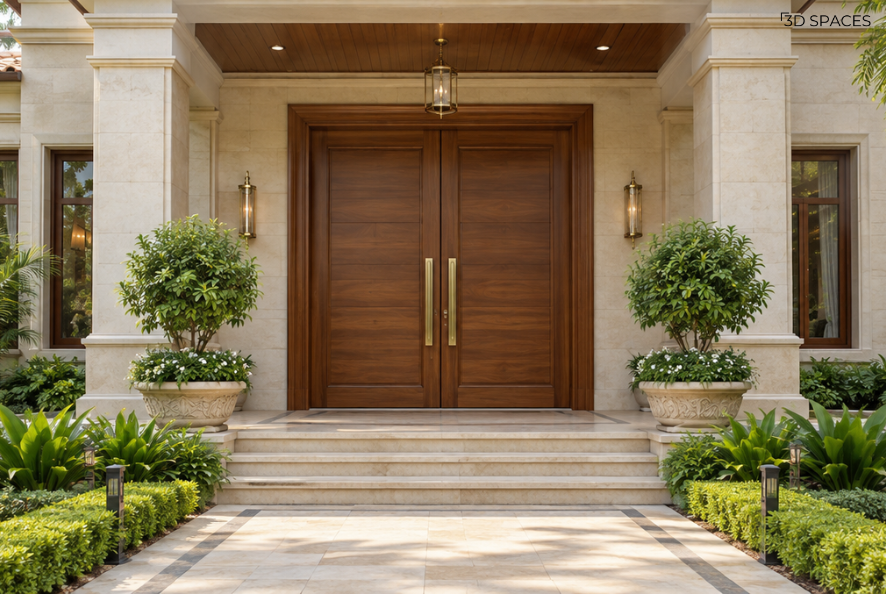
9. Double Wooden Front Door
Double wooden doors create a grand entrance and offer a wider opening when both leaves are designed to operate. They are especially suited to villas and independent houses with generous entrance dimensions.
Broad wood panels, matching handles, and symmetrical detailing can create a balanced appearance.
Best for: Large homes, villas, duplexes, and wide entrance openings.
What to consider: Check the actual clear opening, frame strength, hinge specifications, locking arrangements, and space required for both leaves to swing.
10. Light Oak-Inspired Wooden Door
Light wood finishes create an airy, contemporary appearance. They pair well with white walls, beige flooring, muted greens, and natural textures.
This is a practical style direction for homeowners who prefer a softer look instead of deep brown or highly polished finishes.
Best for: Compact apartments, Scandinavian-inspired interiors, and contemporary homes with light palettes.
What to consider: Choose a durable finish that suits the actual substrate. Light finishes may show certain stains and marks more clearly, depending on the surface.
11. Wooden Door with Matte Black Hardware
A natural wood door paired with matte black hardware creates a clean contrast. The combination suits minimalist interiors and can make even a simple panelled door look carefully designed.
Use a long pull handle, a matching lock set, and discreet hinges where appropriate. The hardware should complement the door rather than overpower it.
Best for: Modern flats, contemporary villas, and industrial-inspired interiors.
What to consider: Prioritise the quality and suitability of the locking system over its appearance. Decorative hardware alone does not improve security.
12. Arched Wooden Front Door
An arched doorway introduces a softer shape than a standard rectangular entrance. It can look particularly attractive in villas, independent houses, and homes with Mediterranean or contemporary Indian architectural influences.
The arch may be part of the surrounding frame rather than the door leaf itself. This distinction matters when planning fabrication and installation.
Best for: Villas, custom-built homes, and entrances designed around curved architectural elements.
What to consider: Confirm whether the existing opening can accommodate an arch before selecting the door. Retrofitting structural openings can involve additional work.
Which Wood Is Best for a Main Door in India?
The best material depends on your budget, design preferences, entrance exposure, and willingness to maintain the door.
Teak is a popular natural timber option, while other hardwoods and engineered wood products may suit different applications. Material selection should be based on the actual product specification rather than appearance alone.
| Material | Main advantages | What to check |
|---|---|---|
| Solid teak | Distinctive grain and natural durability | Timber grade, moisture condition, source, and price |
| Other suitable hardwoods | Different grains, colours, and price points | Species-specific durability and treatment |
| Engineered wood with veneer | Consistent appearance and design flexibility | Core construction, adhesive quality, edge sealing, and moisture suitability |
| Decorative laminate over a suitable door core | Broad finish options and relatively simple surface care | Core quality, edge protection, and exposure conditions |
| Wood-look composite alternatives | Can offer lower-maintenance options in suitable applications | Product specifications, structural suitability, hardware compatibility, and appearance |
For Indian homes, moisture exposure deserves particular attention. Doors exposed to rain, damp entrance floors, or significant humidity changes need appropriate construction and protective finishing. No material should be assumed to be completely weatherproof or termite-proof without evidence from its manufacturer.
The Institute of Wood Science and Technology, under the Indian Council of Forestry Research and Education, documents timber durability and natural resistance. This is a useful starting point when comparing timber species, although a specific door's performance also depends on its construction and maintenance. <Cite refs={["turn329137search4","turn329137search6"]}/>
Is solid wood always better than engineered wood?
Not necessarily. Solid wood offers natural grain and the ability to refinish certain surfaces, but it can respond to changes in moisture. Engineered products can offer more consistent construction, but performance varies by core, adhesive, finish, and intended use.
For a main entrance, ask the supplier for the full door specification, including the core, thickness, frame, edge treatment, hardware, and warranty conditions. Compare complete installed solutions instead of choosing by the surface finish alone.
You can also read Inside a Warm, Personal 3 BHK Home Transformation in Gurugram
Which Wooden Door Finish Looks Best?
The finish influences how the door looks, how its grain appears, and how much maintenance it needs.
Natural clear finish: Shows the grain and works well with teak and other attractive timber surfaces.
Matte finish: Creates a contemporary, understated appearance.
Walnut stain: Adds a deeper brown tone to suitable wood surfaces.
Light oak-inspired finish: Works with neutral, airy interiors.
High-gloss polish: Creates a reflective, formal look but can make scratches and surface imperfections more noticeable.
Painted finish: Offers colour flexibility when the substrate and coating system are suitable for the application.
Always review a physical finish sample in the lighting conditions of your entrance. A brown shade that looks warm in a showroom may appear darker under warm indoor lighting or different against cool-toned flooring.
How Much Does a Wooden Main Door Cost in India?
There is no single price for the latest wooden main door designs. The final cost depends on the door dimensions, timber or core material, design complexity, finish, hardware, frame, and installation requirements.
A simple flush design will generally involve different costs from a custom-carved teak door or a double entrance with metal inlays.
When requesting quotes in Delhi NCR, ask for a clear breakdown of:
Door shutter and core material.
Frame or chaukhat.
Finish, polish, or laminate.
Hinges, handles, locks, and other hardware.
Carving, grooves, inlays, or custom fabrication.
Transportation, fitting, and finishing work.
Applicable taxes and warranty terms.
Ask whether the quote covers the complete installed door or only the shutter. This distinction can make two apparently similar estimates difficult to compare.
For an accurate budget, obtain quotations for the same size, material specification, hardware, and finish from more than one supplier. Current local prices should be verified before committing to a purchase.
You can also read: Bathroom Corner Shelf
How Do You Choose the Right Main Door for Your Home?
Before finalising a design, check the practical details that affect everyday use.
1. Measure the entrance properly.
Measure the existing opening and frame before ordering a custom door. Check the clear opening, frame condition, threshold, and available swing space. If the entrance is being renovated, confirm whether any proposed changes require additional building work or approval.
2. Consider your home's exposure to weather.
A sheltered apartment entrance and an independent house entrance exposed to rain are different applications. Discuss moisture protection, suitable finishes, frame materials, and edge sealing with your supplier.
3. Match the door to the facade and foyer
Use the door's colour and grain to connect the exterior with the interior. For example, a walnut door can work with warm beige flooring, while a light wood finish can complement white walls and muted decor.
If your apartment opens directly into the living room, coordinate the door with a compact foyer, mirror, console, or feature wall without blocking circulation.
4. Prioritise security and hardware.
Choose a suitable lock, strong hinges, a properly installed frame, and hardware compatible with the door construction. If you are considering a smart lock, confirm that the door thickness, core, and lock preparation meet the manufacturer's requirements.
A beautiful door is not automatically a secure door. Construction and installation matter just as much as appearance.
5. Check apartment and society requirements
For flats in Noida, Ghaziabad, Gurgaon, or elsewhere in Delhi NCR, check applicable housing society rules before changing the exterior appearance, frame, or entrance opening. Some buildings have restrictions on visible changes to common-facing doors.
How Do You Maintain a Wooden Front Door?
A wooden main door can retain its appearance for years when its finish and installation suit the conditions around it.
Dust the surface regularly with a soft, dry or appropriately damp cloth, following the finish manufacturer's instructions.
Avoid soaking the wood or allowing water to collect along the bottom edge.
Inspect the top, bottom, and side edges for damaged coatings.
Check hinges, handles, and locks periodically.
Address sticking, swelling, peeling finish, or signs of pests early.
Recoat or refinish the surface when required by the product's maintenance instructions.
For doors exposed to rain, inspect weather protection before and during the monsoon.
Wood naturally responds to changes in moisture. Appropriate sealing and maintenance can reduce the risk of damage, but no finish eliminates every risk. For significant swelling, structural damage, or suspected termite activity, consult a qualified professional.
You may also read: Glass Wardrobe Design: 20+ Stylish Ideas for Modern Bedrooms
What Wooden Main Door Mistakes Should You Avoid?
Choosing appearance over construction: A premium veneer or attractive pattern cannot compensate for an unsuitable core or poorly built frame.
Ignoring the door frame: A heavy door needs a properly specified and installed frame to remain aligned and operate smoothly.
Selecting a dark finish for a small entrance without testing it: Dark wood can look beautiful, but the surrounding lighting and wall colours determine how heavy it feels.
Adding too many decorative elements: Carving, metal strips, bold grooves, and statement handles can compete with one another. Choose one or two focal details.
Forgetting maintenance: Natural wood finishes may require periodic care, particularly in entrances exposed to moisture or sunlight.
Comparing quotes without matching specifications: Always compare the material, size, frame, hardware, finish, and installation scope.
Your main door should feel connected to the rest of your home. Explore entrance, foyer, and interior design solutions with 3D Spaces to create a coordinated look that works for your layout and lifestyle.
Your main door should feel connected to the rest of your home. Explore entrance, foyer, and interior design solutions with 3D Spaces to create a coordinated look that works for your layout and lifestyle.
How Can 3D Spaces Help You Plan Your Home Entrance?
At 3D Spaces, we believe that good interior design brings appearance and practicality together. Your main door, entrance wall, foyer lighting, flooring, and nearby storage should work as one design rather than separate choices.
For homeowners planning interiors in Delhi NCR, a coordinated design process can help evaluate colour combinations, finishes, space planning, and how the entrance connects with the rest of the home. Where included in the project, 3D visualisation can help you review the proposed design before execution.
The aim is simple: make informed decisions about the materials, appearance, and layout before work begins.
Frequently Asked Questions
-
Minimalist wooden doors, vertical fluted designs, walnut finishes, and geometric panel doors are good options for modern homes. Choose according to your entrance dimensions, surrounding colours, maintenance preferences, and budget.
-
Teak is a popular choice because of its natural durability and distinctive grain. Other suitable hardwoods and engineered products can also work well. Compare the material specification, moisture exposure, construction quality, and maintenance requirements before choosing.
-
Teak can be a worthwhile choice for homeowners who value natural timber, its appearance, and its durability. Whether it is worth the additional expense depends on the wood grade, construction, finish, budget, and intended use.
-
Contemporary design directions include vertical grooves, natural and walnut-inspired finishes, geometric panels, restrained brass detailing, minimalist hardware, and traditional craftsmanship used in cleaner architectural settings. Choose a style that suits your home rather than relying on trends alone.
-
A minimalist flush door, a subtle panel design, or a vertical-grooved door works well in many apartments. Consider the available entrance space, society rules, frame condition, security requirements, and the appearance of the shared corridor.
-
They can be suitable when the timber or engineered product, construction, finish, and installation match the conditions. Pay particular attention to direct rain exposure, moisture at the threshold, summer heat, and monsoon humidity.
-
The price varies with size, material, finish, carving, frame, hardware, and installation. Request an itemised quote and confirm whether the price covers the shutter alone or the complete installed door.
